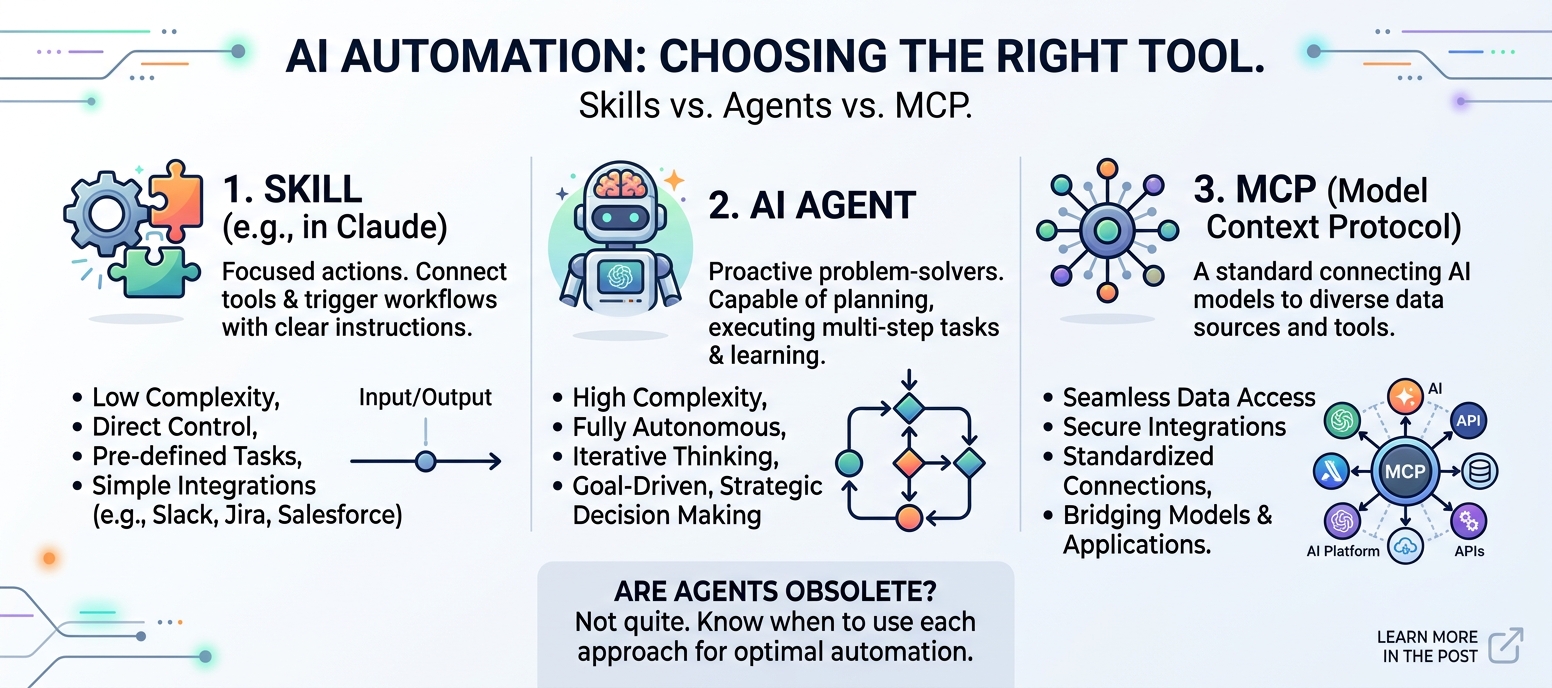
As AI tools become more capable, terms like AI agent, skill, LLM, and MCP are appearing everywhere. Although these concepts are related, they serve different purposes.
Understanding the differences is important, particularly if you’re planning to build AI-powered applications rather than simply use an existing AI assistant.
Let’s break them down, starting with the relationship between an AI agent and a skill.
1. AI Agent vs. Skill

AI Agent
An AI-powered system that can interpret a goal,
decide what steps to take, use tools, and execute a task.
Example: An agent investigates why a
Jira deployment failed, searches related Confluence
documentation, and prepares a root-cause summary.

Skill
A reusable set of instructions, procedures, or
specialized knowledge that helps an AI perform a
particular type of task consistently.
Example: A Jira investigation skill
instructs the AI to examine error logs, identify
dependencies, check related incidents, and distinguish confirmed facts from assumptions.
2. How Do Agents and Skills Work Together?
Imagine you want to investigate a failed provisioning job.

The agent coordinates the work, the skill provides the procedure, and the tools provide access to the evidence.
3. How does this relate to LLMs, MCP, and software?
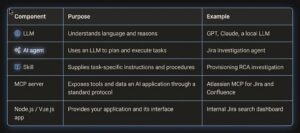
Each component solves a different problem. An application can combine them, but it does not necessarily need all of them.
One important detail: a skill does not necessarily require an AI agent. It could be a written procedure used by a person, or instructions loaded by an AI system. Likewise, an agent does not always need a separately defined skill.
4. A Practical Example: Building a Jira Investigation Application
Suppose you build an application to search Jira. There are two ways to approach the problem.
Option A: A regular application
You define the search
You could build a conventional application that calls Jira APIs or uses an MCP client. Your code would define the search behavior, process the results, and display them to the user. You would not need an LLM or an AI agent.
The application does exactly what you programmed it to do. It can be a good choice when the tasks are well-defined and predictable.
Option B: An AI-powered application using an agent and a skill
You describe the goal
You ask:
“Investigate recurring provisioning failures over the last 30 days. Identify common dependencies, group related incidents, and distinguish confirmed causes from hypotheses.”
Instead of requiring the user to specify every search and filter, an AI-powered application could interpret the request and coordinate the investigation.
The agent determines which searches to perform, uses Jira and Confluence tools to gather evidence, and follows a skill that defines how to investigate incidents and report findings.
By combining evidence from multiple sources, the system could identify recurring patterns across incidents, compare historical failures, and organize the findings into an investigation report.
This architecture is more flexible for open-ended tasks, but it adds complexity and requires careful validation of the AI’s conclusions.
Which option should you choose?
Neither approach is universally better.
A conventional application can be simpler, more predictable, and easier to test for well-defined operations. An AI-powered application can handle more flexible requests, especially when the user does not know in advance exactly which searches or investigative steps will be necessary.
You can also combine the two approaches. For example, a Vue.js interface could provide conventional search filters alongside an AI-assisted investigation feature.
That lets users choose between explicit, predictable searches and more flexible, natural-language investigations.
The Bottom Line
AI agents, skills, LLMs, and MCP solve different problems.
An LLM provides language understanding and reasoning capabilities. An agent coordinates actions toward a goal. A skill supplies reusable instructions. MCP provides a standardized way to connect an AI application to external tools.
Understanding these distinctions helps you choose the right architecture for the problem you’re solving.
Sometimes a straightforward application is all you need. In other cases, combining an agent with skills and external tools can support tasks that would be cumbersome to implement as a collection of fixed rules.
The key is not to introduce AI components simply because they are available. Start with the problem, determine what the application needs to accomplish, and choose the architecture that best fits the task.

Sami Joueidi holds a Master’s degree in Electrical Engineering and brings over 15 years of experience leading AI-driven transformations across startups and enterprises. A seasoned technology leader, Sami has led customer adoption programs, cross-functional engineering teams, and go-to-market strategies that deliver real business impact.
He’s passionate about turning complex ideas into practical solutions, and about helping teams bridge the gap between innovation and execution. Whether architecting scalable systems or demystifying AI concepts, Sami brings a blend of strategic thinking and hands-on problem-solving to every challenge. © Sami Joueidi and www.cafesami.com, 2025. Feel free to share excerpts with proper credit and a link back to the original post.