
AI is changing the way we work faster than most of us realize.
It can write code, analyze documents, generate designs, answer customers, summarize research, manage workflows, and increasingly take actions on our behalf.
The conversation has moved beyond whether AI can do the work. It is becoming a question of whether AI will eventually do enough of the work that we no longer need as many people to do it.
And that raises a question I have been thinking about for a very long time: When we make a system more efficient, what exactly are we optimizing for and who pays the price?
I have seen this before. Not with AI, but with automation.
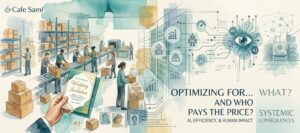
Years ago, I helped implement an automated control system in a large warehouse operation. The objective was straightforward: make the operation more efficient, reduce repetitive manual work, and reduce the potential for injuries.
From an engineering perspective, it worked. But there was another consequence. Once the system was doing more of the work, fewer people were needed to do it.
I knew the people behind the numbers
This wasn’t an operation I understood from behind a desk. There were roughly 700 people on each shift working across picking, packing, shipping, receiving, returns, and the conveyor systems that connected everything together.
I spent a lot of time on the shop floor. I wanted to understand how the operation really worked not just how it looked on a process diagram. The people doing the work taught me things no engineering document could. They knew where the conveyors really jammed. They knew which processes worked on paper but failed in practice.
I didn’t have an ego about being the engineer. I needed to understand their world.
Over time, some of those people became friends. I was even invited to the wedding of one employee’s daughter.
So when the automation eventually translated into fewer people being needed, I didn’t see a headcount number. I saw people I knew.
The system had succeeded. The business case had succeeded. But people lost their jobs.
The other side of efficiency
That experience didn’t make me anti-automation. Quite the opposite. I believe automation can make dangerous work safer, eliminate repetitive tasks, improve quality, and increase productivity.
But I also learned that technical success and human impact are two different measures of success. An engineer can optimize a system. A company can optimize a workforce. But society has to live with the consequences.
And today, AI is taking that same equation much further.
Automation once primarily challenged physical work. AI is now reaching into software development, finance, customer service, marketing, legal services, engineering, and management.
If work can be modeled, generated, predicted, or executed by software, AI can increasingly participate in it. With agentic AI, we’re moving from systems that assist us to systems that can actually take actions and make decisions.
Would you trust an AI agent to manage your finances, your career, or your livelihood? Would you trust it to decide who gets hired, promoted, or let go?
Before we hand over those responsibilities, we should ask what exactly we’re optimizing for.
The economic question
There is another question that concerns me. If AI allows companies to produce more with fewer people, what happens to purchasing power when fewer people earn an income? Productivity can increase supply, but economies also depend on people having the means to participate in demand. I don’t know where that balance ultimately settles but I think we need to be asking the question now.
What should we optimize for?
I am an engineer. I believe in science, innovation, and progress. Some of the things AI is helping us accomplish in scientific discovery, medicine, engineering, and research are extraordinary.
I don’t want to slow that progress. But my experience on that warehouse floor taught me something I still carry with me: Building a system that works is only half the job. We also have to think about what happens when it works.
The difficult question isn’t simply can we automate this? Increasingly, the answer is yes.
The harder question is should we and how do we make sure the gains from that progress don’t come at the expense of the people we are trying to help?
Because perhaps the greatest challenge of AI isn’t building machines that can do more. It’s making sure that, as they do more, people still have a meaningful place in the economy we are building.

Sami Joueidi holds a Master’s degree in Electrical Engineering and brings over 15 years of experience leading AI-driven transformations across startups and enterprises. A seasoned technology leader, Sami has led customer adoption programs, cross-functional engineering teams, and go-to-market strategies that deliver real business impact.
He’s passionate about turning complex ideas into practical solutions, and about helping teams bridge the gap between innovation and execution. Whether architecting scalable systems or demystifying AI concepts, Sami brings a blend of strategic thinking and hands-on problem-solving to every challenge. © Sami Joueidi and www.cafesami.com, 2025. Feel free to share excerpts with proper credit and a link back to the original post.