There was a time when watching a movie at home felt simple, if slightly inconvenient.
You had cable. You could occasionally order an on-demand movie through your set-top box, or you could drive to Blockbuster, pick out a VHS or DVD, and remember to return it on time.
The experience had clear physical limits, but it had one foundational rule: When you paid to rent a movie, you watched the movie—not a barrage of commercial interruptions.
Then streaming arrived.
The Promise of Netflix
Netflix changed the equation.
For a relatively small monthly fee, we could access a large library of movies and shows whenever we wanted. No trip to Blockbuster. No late fees. No scheduled programming. And perhaps most importantly: no commercial interruptions.
It was a brilliant business model. It solved real customer problems, removed friction, and delivered something people actually wanted: good content, available anywhere, anytime, for one predictable monthly fee.
For a brief period, it felt like technology had finally put the viewer first. Streaming delivered on that promise—until the followers arrived.
The Subscription Multiplier
The success of Netflix did not go unnoticed. Disney, HBO, Apple, Paramount, and others realized something important: why license your valuable content to someone else’s platform when you can create your own streaming service and collect the subscription revenue yourself?
From a business perspective, the logic was understandable. The problem was what it did to the customer experience.
Content that had once been available through Netflix began moving into separate, exclusive silos. What had started as one simple subscription became:
The friction that streaming promised to eliminate came back in a different form. Now we had to remember which service carried which show, which subscription was worth keeping, and where the next movie we wanted to watch was hiding.
Streaming was supposed to make entertainment simpler. Instead, we created a new problem: content fragmentation. And the monthly bill started looking less and less different from the cable bill we thought we had escaped.
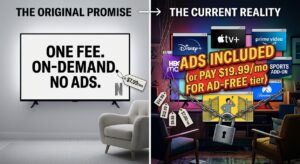
The Streaming Evolution: How a single $7.99/mo ad-free subscription fragmented into multiple paid tiers, lock-in, and commercial interruptions.
The Monetization Trap
Then something even more interesting happened: the advertisements came back.
Think about the original appeal of streaming. One of the primary reasons people embraced it was to escape the interruptions of traditional television. Now many streaming services offer plans with advertisements. And if you don’t want the ads? Pay more.
Customer Pays Subscription ➔ Advertiser Pays Platform ➔ Customer Pays Extra to Remove Ads
The business model became remarkably efficient:
-
You pay a monthly subscription for access.
-
Advertisers pay the platform to reach you.
-
You watch the advertisements.
-
If you don’t want to watch them, you pay an additional fee.
The platform found a way to monetize both sides of the relationship—and then charge the customer again to opt out.
That is a very different proposition from the one that made streaming so attractive in the first place.
Why YouTube Is Different
This is where I see an important distinction between YouTube and paid streaming services.
YouTube’s model is relatively clear. It gives users access to an enormous amount of content for free. Advertisers pay to reach the audience, and users watch the content and the advertisements. If users don’t want the ads, they can choose to pay for Premium.
I may not like the ads, but I understand the deal: free access in exchange for advertising. That is a legitimate business model.
Paid streaming services feel different. I am already paying for access. The company is collecting subscription revenue from me. Advertisers are also paying the company to reach me. And if I don’t want the advertisements, I am asked to pay even more.
That’s where the original value proposition starts to feel eroded.
From Innovation to Monetization
The issue isn’t that companies need to make money. Of course they do. The issue is what happens when a customer-friendly model becomes so successful that the company starts optimizing every possible source of revenue.
The original promise was simple:
-
One reasonable subscription
-
A large library
-
On-demand access
-
No commercial interruptions
Over time, the model evolved into:
-
Multiple subscriptions
-
Fragmented content
-
Higher total costs
-
Advertising and premium tiers
-
Additional fees to remove the advertising
We often talk about innovation as if every new business model automatically makes the world better. But innovation doesn’t guarantee a better customer experience. Sometimes a company can take something genuinely innovative and gradually optimize it until the original reason customers loved it gets buried underneath the business model.
The System Gets Optimized
This is where the issue becomes bigger than Netflix, Disney, Apple, or any other streaming company. It’s a pattern I see in technology and systems engineering all the time.
A company finds something customers love. The business grows. Leadership starts looking at the metrics:
-
How do we increase revenue?
-
How do we increase engagement?
-
How do we increase advertising revenue?
-
How do we increase premium-tier adoption?
Individually, every decision can make sense. The problem is what happens when we optimize each metric independently without looking at the health of the entire system.
Subscription revenue goes up. Advertising revenue goes up. Premium subscriptions go up. The metrics improve. But the customer now has multiple subscriptions, a larger monthly bill, more advertisements, and another fee if they want the experience they originally expected.
We optimized the parts. We lost sight of the whole.
What Happened to the Promise?
I remember why streaming was exciting. It wasn’t because I wanted another subscription, another app on my television, or more advertisements.
I wanted something simple: to watch what I wanted, when I wanted, without being interrupted.
Netflix solved that problem beautifully. It took something inconvenient and made it simple. Somewhere along the way, we went from paying a reasonable fee to watch what we want, to subscribing to several services, hunting down where our show lives, watching advertisements, and paying extra if we don’t want them.
Different technology. Different companies. Different apps. But increasingly, the same old frustration.
And that leaves me with a question: What happened to the promise of streaming?
Did we actually improve the way we watch entertainment? Or did we simply replace the cable bill with a collection of subscriptions—and then pay extra to recover the experience streaming originally gave us?
Maybe the real lesson isn’t about streaming at all. Maybe it’s about what happens when we optimize the business model so aggressively that we forget why customers wanted the product in the first place.
The metrics improve.
The revenue improves.
The customer experience deteriorates.
The system suffers.

Sami Joueidi holds a Master’s degree in Electrical Engineering and brings over 15 years of experience leading AI-driven transformations across startups and enterprises. A seasoned technology leader, Sami has led customer adoption programs, cross-functional engineering teams, and go-to-market strategies that deliver real business impact.
He’s passionate about turning complex ideas into practical solutions, and about helping teams bridge the gap between innovation and execution. Whether architecting scalable systems or demystifying AI concepts, Sami brings a blend of strategic thinking and hands-on problem-solving to every challenge. © Sami Joueidi and www.cafesami.com, 2025. Feel free to share excerpts with proper credit and a link back to the original post.