
There are moments when you learn something and think, Wow.
Not because what you learned was necessarily new, but because you suddenly realize that something you had been looking at for years was telling you a story you couldn’t previously read.
I had one of those moments recently when I came across Euler’s identity:
eⁱᵖⁱ + 1 = 0
If you’re anything like me, your first reaction might be: Okay… that’s nice. But what am I supposed to do with that?
As an electrical engineer, I understood the mathematics behind this equation years ago. But understanding the mathematics and stopping to appreciate what it represents are two different things.
This time, I stopped and looked at the equation from a different perspective. I started thinking about what each symbol represented, where these ideas came from, and how they came together in one remarkably simple expression.
That’s when the equation became something completely different.
It wasn’t just a formula anymore. It was a story.
When the Symbols Start Talking
The remarkable thing about Euler’s identity isn’t that it is complicated. In fact, part of its beauty is that it is incredibly simple. Five fundamental mathematical ideas come together in one short expression: zero, one, π, e, and i.
Each represents something completely different:
-
Zero represents nothing, the additive identity.
-
One represents unity and scaling.
-
π connects to the geometry of the circle.
-
e appears naturally when we describe continuous growth and change.
-
i, the square root of -1, extends mathematics into the world of complex numbers.
Ideas emerged through centuries of human curiosity across different civilizations, and centuries later, Euler’s work revealed a remarkable relationship between some of these seemingly unrelated ideas.
What makes it so fascinating is that the same mathematical language connects concepts such as exponential change, rotation, circles, and complex numbers. Euler’s formula is deeply connected to the mathematics we use to describe waves, signals, electricity, and many other physical phenomena.
And I had this strange reaction:
Wow.
Not wow, I understand all the mathematics.
I don’t.
The wow was the realization that something I might have once dismissed as mathematical gibberish was actually telling me something profound about the way mathematics—and, in many ways, the world—fits together.
The equation hadn’t changed.
I had.
I had learned enough to see something that had been there all along.
Maybe We Don’t Dislike Math. Maybe We Never Learned How to See It.
I have always found it interesting when someone says, “I don’t like math.”
I understand why. For many of us, mathematics was something we encountered in school as formulas to memorize, problems to solve, and tests to pass.
We learned what to do, but how often were we given the opportunity to stop and ask:
-
Why does this exist?
-
Who needed it?
-
What problem was someone trying to solve?
-
What did they discover, and why should I care?
There is a difference between learning a formula and understanding the idea behind it.
One allows you to pass the test; the other can change the way you see the world.
That distinction applies to much more than mathematics.
Discovering the Same Truth Through Music
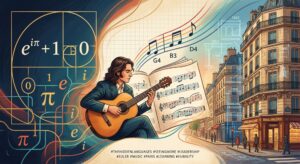
When my son started learning piano, I decided to take up classical and solo guitar. Part of that came from my love of guitar music—Ritchie Blackmore has been one of my idols for a very long time, and I simply wanted to play.
Eventually, I hit a wall. I couldn’t progress without understanding the language behind the music, which meant learning music theory.
I had to understand things that initially seemed as abstract as a mathematical equation: quarter notes, dotted notes, rests, timing, scales, and intervals sitting on a page.
At first, they were just symbols.
Then something shifted.
As I began to understand what they meant, I could look at a sheet of music in complete silence and begin to imagine what it sounded like before I played it.
The marks on the page weren’t just instructions for my fingers—they were a language.
The composer had written something down, and I was learning how to read it.
Again, the page hadn’t changed.
I had.
The Same Street Can Tell Two Completely Different Stories
I think about this whenever I travel.
Imagine walking through Paris. You can see beautiful buildings, balconies, cafés, boulangeries, narrow streets, and old stone.
Or you can know a little about what you’re looking at.
When you understand the history:
-
The architecture tells you something about the era that built it.
-
The neighborhood tells you something about the social shifts over centuries.
-
The local boulangerie tells you a story of craftsmanship and trade.
You haven’t entered a different city; you’ve simply learned how to read more of it.
The world is full of things we can see without really seeing.
We Are Surrounded by Languages
Mathematics is one language.
Music is another.
Architecture, history, science, and leadership are others—along with countless languages we don’t recognize yet because we haven’t learned them.
-
To someone who understands mathematics, an equation reveals hidden relationships.
-
To a musician, a page of notes contains emotion before a single string is plucked.
-
To an architect, a building tells a story through proportion and design.
-
To a historian, a street corner holds generations of human experience.
And this isn’t limited to subjects or disciplines.
It applies to cultures and people, too.
When we take the time to understand someone’s background, experiences, perspective, or the world they came from, we often see something very different from what we saw at first glance.
The meaning was there long before we understood it.
That’s what I find so humbling.
Understanding What We’re Using
This is also something I regularly remind my team:
Take training seriously. Seek to understand the capabilities of the software you’re using or selling.
Don’t just learn which buttons to click.
Understand what the software can actually do.
And when you see a capability, don’t simply think:
“I’ll never use that.”
Ask why it exists.
A company doesn’t invest significant resources to add a capability to software for no reason.
Think about everything that happens behind the scenes.
Architects have to think through the design. Engineers have to build it. People have to test it. Teams have to release, document, support, and maintain it.
And all of that takes time, money, opportunity cost, and risk.
Companies don’t go through all of that simply to add another checkbox.
There is usually a problem someone is trying to solve.
There is usually a customer need behind the capability.
That’s why I encourage my team not to simply memorize what a product does.
Seek to understand the capability and the problem it was designed to address.
The same principle applies to mathematics.
If we see a formula and dismiss it as gibberish, we may be missing the story behind it.
If we see a software capability and never ask why it exists, we may be missing the value behind it.
Understanding changes what you see.
Perhaps Education Should Give Us More Than Answers
Maybe this is what we sometimes miss in standard education.
We teach the formula, the notation, the date, and the definition.
Those things matter, but we should spend more time showing people why they matter.
When you understand the story behind something, learning stops feeling like memorization and becomes discovery.
A formula becomes a window.
A musical note becomes a sound waiting to happen.
A building becomes history.
A street becomes a story.
A software capability becomes a solution to a problem rather than just another feature.
And something that once looked complicated or meaningless suddenly becomes beautiful.
The Things We Haven’t Learned to See Yet
I don’t pretend to understand everything behind Euler’s identity, but that isn’t the point.
The point is the feeling of discovering that there is more there than I initially thought—and wondering how often that happens in our daily lives.
-
How many people have said, “I don’t like math,” when what they really needed was someone to show them the beauty behind the symbols?
-
How many people have looked at music and never had the opportunity to understand its language?
-
How many places have we visited without knowing the stories beneath our feet?
-
How many people have we judged simply because we didn’t understand their language, their experience, or the world they came from?
-
How many software capabilities have we dismissed because we never took the time to understand the problem they were designed to solve?
How much beauty might we be walking past every day simply because we haven’t yet learned how to read it?
Maybe the world isn’t becoming more interesting as we learn.
Maybe we are becoming better at seeing what was already there.
Not knowing more for the sake of knowing more—but seeing more, feeling more, connecting things that once seemed unrelated, and occasionally stopping in the middle of it all and thinking:
Wow.

Sami Joueidi holds a Master’s degree in Electrical Engineering and brings over 15 years of experience leading AI-driven transformations across startups and enterprises. A seasoned technology leader, Sami has led customer adoption programs, cross-functional engineering teams, and go-to-market strategies that deliver real business impact.
He’s passionate about turning complex ideas into practical solutions, and about helping teams bridge the gap between innovation and execution. Whether architecting scalable systems or demystifying AI concepts, Sami brings a blend of strategic thinking and hands-on problem-solving to every challenge. © Sami Joueidi and www.cafesami.com, 2025. Feel free to share excerpts with proper credit and a link back to the original post.