For anyone building platform engineering tools or infrastructure automation, framing AI components as modular services rather than a monolithic silver bullet is critical. The distinction between protocol layers (MCP), orchestration runtime (Agents), deterministic guardrails (Skills), and reasoning engines (LLMs) clarifies how these pieces actually fit into a modern platform architecture.
While deeply interconnected, these terms solve fundamentally different problems. If you are architecting AI-powered platform applications rather than just chatting with a general-purpose assistant, understanding these boundaries is non-negotiable. Let’s break down the stack.
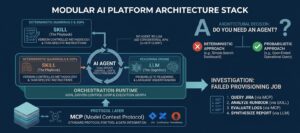
A service-oriented breakdown of modern AI architecture—mapping MCP (Protocol Layer), Agents (Orchestration Runtime), Skills (Deterministic Guardrails), and LLMs (Reasoning Engine).
1. What Is an LLM? (The Reasoning Engine)
An LLM provides raw language understanding, pattern recognition, and probabilistic reasoning. It interprets inputs, evaluates context, and generates structured outputs or natural language.
-
The Role: The cognitive core. It can reason about a problem, but it has no persistent agency, no native access to external tools, and no inherent execution loop.
2. What Is an AI Agent? (The Orchestrator)
An AI agent is a runtime system that uses an LLM to pursue a specific goal, dynamically determine the next action, and interact with tools to complete a workflow.
Consider an open-ended operational query:
“Investigate why our latest software provisioning job failed.”
An agent coordinates the investigation loop:
-
Queries Jira for the failed deployment ticket.
-
Pulls related infrastructure logs and historical incident data.
-
Searches Confluence for relevant runbooks.
-
Cross-references the evidence to isolate root causes.
-
Synthesizes a structured incident report with recommended remediation steps.
The Distinction: The agent coordinates the execution graph. Depending on its design and findings, it decides which path to take next, transforming a static model into an active investigator.
3. What Is a Skill? (The Standard Operating Procedure)
A skill provides reusable instructions, domain knowledge, or methodological procedures for performing a specific task.
Think of a provisioning investigation skill as a codified SOP:
-
Isolate the failed operation and map its downstream dependencies.
-
Query telemetry and incident history.
-
Distinguish confirmed metrics from heuristic assumptions.
-
Evaluate recurring failure patterns against known error budgets.
-
Document the evidence trail supporting each conclusion.
The Distinction: A skill is a version-controlled playbook. It replaces improvisation with structural rigor, guiding either a human engineer or an AI agent through a repeatable methodology.
4. Where Does MCP Fit In? (The Protocol Layer)
Model Context Protocol (MCP) provides a standardized protocol for AI applications to discover and consume tools and data exposed by external systems.
For example, an Atlassian MCP server standardizes how tools expose Jira and Confluence capabilities. An AI application uses that protocol to securely search issues and retrieve documentation.
The Distinction: MCP does not make an application an agent. It simply standardizes the plumbing—connecting the application to external APIs and data sources. The application still requires internal logic to orchestrate how those capabilities are wielded.
5. Architectural Decision: Do You Need an Agent at All?
Engineering teams often rush to inject agents into everything. In practice, many problems are better solved with conventional software.
-
Deterministic Approach: If you are building a Vue.js dashboard to search Jira issues, write a standard Node.js service that calls Jira APIs directly. You don’t need an LLM, an agent, or MCP. Deterministic code is faster, cheaper, and entirely predictable.
-
Probabilistic Approach: If you are building an assistant where a user can say, “Find recurring provisioning failures, trace common dependencies, and summarize likely infrastructure bottlenecks,” you have an open-ended exploratory problem. Here, an LLM interprets intent, an agent coordinates cross-system queries, skills enforce investigation methodology, and MCP tools retrieve the telemetry.
This flexibility comes with trade-offs: higher latency, compute costs, and the engineering overhead of validating non-deterministic outputs.
Conclusion
AI components are not interchangeable building blocks; they address distinct layers of a distributed architecture:
-
LLM: Language understanding and reasoning.
-
Agent: Goal-driven orchestration and control loops.
-
Skill: Reusable playbooks and methodological guardrails.
-
MCP: Standardized tool and data integration protocols.
Start with the problem domain, not the technology. If a deterministic API route or a well-defined script solves the issue, use it. Save agentic architectures for open-ended, multi-step workflows where fixed rules fall short.

Sami Joueidi holds a Master’s degree in Electrical Engineering and brings over 15 years of experience leading AI-driven transformations across startups and enterprises. A seasoned technology leader, Sami has led customer adoption programs, cross-functional engineering teams, and go-to-market strategies that deliver real business impact.
He’s passionate about turning complex ideas into practical solutions, and about helping teams bridge the gap between innovation and execution. Whether architecting scalable systems or demystifying AI concepts, Sami brings a blend of strategic thinking and hands-on problem-solving to every challenge. © Sami Joueidi and www.cafesami.com, 2025. Feel free to share excerpts with proper credit and a link back to the original post.