When I first joined the platform team, one of the most common questions from leadership was blunt:
“Can we trust this platform to be compliant — all the time, not just on audit day?”
That question has always framed my approach. At the Senior Manager and Director level, compliance isn’t just a checkbox; it’s a strategic enabler. Every architectural decision, every deployment strategy, and every integration flows from the principle: protect patients, partners, and the business.
Compliance Is a Business Conversation First
I don’t start leadership discussions with encryption algorithms or FHIR payloads. I start with outcomes:
- Can we guarantee privacy for patient data?
- Can we demonstrate regulatory adherence at any moment?
- Can we move fast without increasing risk?
When you frame compliance as a business risk — not just a technical requirement — executives immediately understand the stakes.
Turning Regulations Into Platform Principles
HIPAA, CLIA, IVDR, FDA, GLP — the list of regulations can feel overwhelming. The trick is not memorizing every detail; it’s embedding compliance into the platform design:
- Data encryption by default: At rest and in transit, ensuring patient data is protected without manual intervention.
- Identity and access management (IAM): Fine-grained permissions to enforce least-privilege principles automatically.
- Auditability baked into the platform: Every action is logged, traceable, and immutable.
From a leadership perspective, this isn’t about checking boxes. It’s about reducing exposure, enabling business continuity, and building partner trust.
Continuous Compliance: Making Audits Predictable
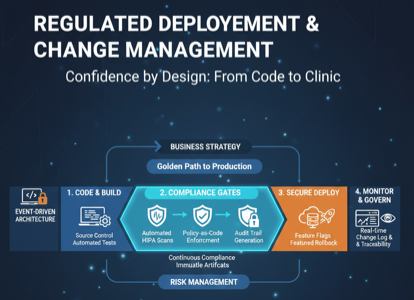
Traditional audits are stressful because they’re episodic. Our approach is continuous compliance, where the platform validates itself in real-time:
- Automated pipelines check for regulatory violations with every deployment
- Security policies and access controls are continuously monitored
- Reports can be generated at any time, turning “audit day” into a non-event
This approach shifts compliance from a reactive chore to a proactive capability — and that’s something executives instantly value.
Cloud-Native, But Regulated
Many people assume that “cloud-native” means faster but riskier. The truth is the opposite — a well-architected cloud platform allows us to enforce compliance programmatically:
- Infrastructure as Policy: compliance rules are embedded in Terraform, Kubernetes, and CI/CD pipelines
- Multi-tenant isolation: each lab, partner, or clinical workflow is segregated to prevent accidental data leaks
- Real-time observability: leadership dashboards show not just uptime but regulatory posture
Technically sophisticated, yes. But the conversation with leadership is always framed around trust, risk, and speed to market.
Why Compliance and Innovation Are Not Opposites
One of the hardest lessons I’ve learned is that compliance doesn’t have to slow you down. When embedded into platform design:
- Teams can deploy safely without constant manual approvals
- New labs and clinical partners can onboard faster
- Audits become predictable rather than disruptive
Compliance becomes a strategic lever, not a roadblock — and that’s the message that resonates at the director level.
Closing Thought
At the end of the day, building a cloud-native platform in healthcare isn’t about the latest tech stack or frameworks. It’s about trust, predictability, and enabling the business to achieve its mission.
HIPAA, CLIA, IVDR, FDA — these aren’t constraints; they’re guardrails. When your platform enforces them by design, you free your teams to innovate safely, scale efficiently, and accelerate clinical outcomes.
This final post closes the series, showing that strategy, architecture, and compliance aren’t separate concerns — they’re inseparable parts of a platform leader’s job.

Sami Joueidi holds a Master’s degree in Electrical Engineering and brings over 15 years of experience leading AI-driven transformations across startups and enterprises. A seasoned technology leader, Sami has led customer adoption programs, cross-functional engineering teams, and go-to-market strategies that deliver real business impact.
He’s passionate about turning complex ideas into practical solutions, and about helping teams bridge the gap between innovation and execution. Whether architecting scalable systems or demystifying AI concepts, Sami brings a blend of strategic thinking and hands-on problem-solving to every challenge. © Sami Joueidi and www.cafesami.com, 2025. Feel free to share excerpts with proper credit and a link back to the original post.