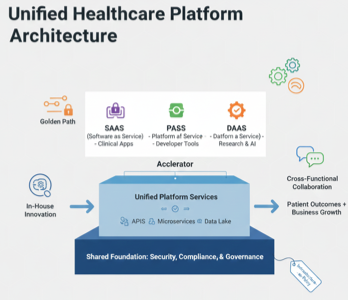
A few weeks ago, I was in a room with our R&D, Regulatory, and Commercial leads debating a new platform design. The question on the table was deceptively simple:
How do we scale this platform without breaking security or making it impossible to change?
At first glance, it sounds like a technical question — auto-scaling groups, Kubernetes clusters, database sharding. But at the senior management level, it’s really a strategic question about risk, investment, and trust.
The Tradeoff Conversation Begins
When I talk to leadership about scalability, security, and modularity, I don’t start with diagrams. I start with scenarios.
- What happens if a lab suddenly doubles the number of samples we process overnight?
- What if a new regulatory requirement mandates additional auditing across all workflows?
- How quickly can a partner team ship a new clinical workflow without waiting on the platform team?
These questions guide every technical decision. They force us to balance operational maturity against market readiness, rather than building a perfect platform that no one can deliver on.
Modularity: The Secret Weapon
One of the most powerful levers we have is modularity — intentionally designing parts of the platform to be independent, composable, and replaceable.
I often explain it like this in leadership conversations:
Think of the platform as a city. We can build roads, water systems, and power grids independently, but they all have to connect without breaking. That’s what modularity buys us: flexibility without chaos.
Technically, modularity shows up as service boundaries that can evolve independently, event-driven architecture to decouple teams, and explicit APIs and contracts for lab and clinical integrations.
From a business perspective, it means we can iterate faster, isolate risk, and onboard new partners without expensive rewrites.
Security Is Not a Constraint — It’s a Leadership Lever
When executives hear the word security, their instincts often go to cost or friction. I try to reframe it as enabling trust and speed.
Instead of “encrypt all the things,” we invest in continuous compliance pipelines. Audits become predictable, and teams don’t lose weeks preparing for them.
Instead of manual approvals for every deployment, we build golden paths with guardrails that enforce security automatically.
This approach lets teams move quickly without exposing the company to regulatory risk — which is ultimately what leadership cares about.
Scaling Without Over-Engineering
One of the most common traps is over-engineering: building a platform that can scale to millions of users when the business only needs thousands today.
Here’s how I frame it with leadership:
We don’t design for theoretical maximums. We design for predictable growth, with modular components that can scale incrementally. It’s cheaper, faster, and less risky.
From a technical standpoint, this means auto-scaling only where it adds value, using cloud-native infrastructure to absorb spikes, and deferring complexity until the business actually demands it.
From a business standpoint, it means you’re not locking capital or creating unnecessary operational overhead before the market is ready.
Bringing It All Together
The real work in this role isn’t writing code or spinning up clusters. It’s managing tradeoffs, enabling teams, and communicating decisions in terms the business understands.
When leadership asks whether the platform can scale, whether it’s secure, and whether it can change quickly, they aren’t asking about Kubernetes or Docker. They’re asking whether we can deliver outcomes reliably, pivot when clinical or regulatory needs change, and invest wisely in the platform.
Balancing scalability, security, and modularity isn’t just an engineering exercise. It’s a strategic conversation about risk, cost, and trust.
Closing Thought
Every platform decision sends a message to the business: move fast, but don’t compromise trust. Grow efficiently, but stay ready for the unexpected.
In the next post, I’ll share how these architectural principles show up in real integration work — connecting lab systems with clinical systems without losing control or slowing down innovation.