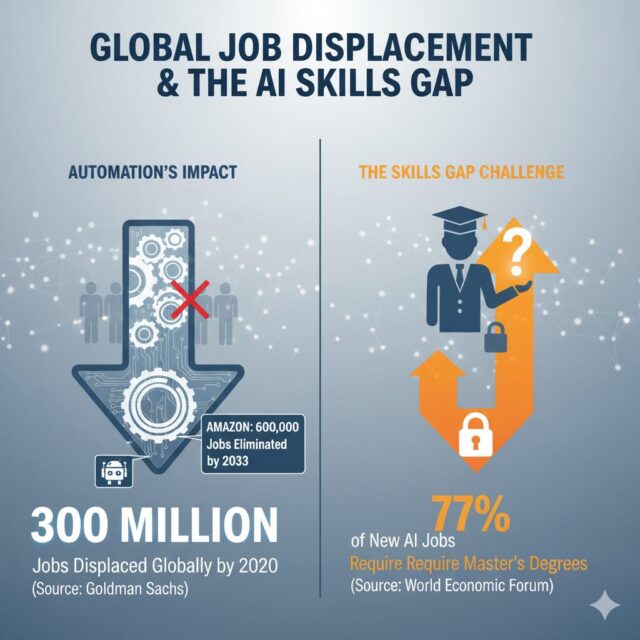
A recent discussion about Amazon’s plan to automate large portions of its operations, stemming from an analysis of robotics in logistics, sparked renewed debate about the long-term impact of automation. The company reportedly expects to save more than $12.6 billion by replacing human labor between 2025 and 2027. This financial efficiency is tied to a much larger projection: company analysis warns that over 600,000 positions that would have otherwise existed at Amazon simply won’t by 2033. Globally, this trend is escalating, as Goldman Sachs estimates 300 million jobs worldwide will be displaced by AI and robotics by 2030. While the World Economic Forum predicts a net increase in total jobs, they warn of a substantial skills gap, noting that 77% of the new AI-related roles will require a Master’s degree or higher.
Supporters describe this as the natural evolution of industrial efficiency: automation reduces errors, eliminates repetitive and dangerous tasks, and cuts operational costs. From a technical perspective, the improvements in speed, precision, and safety are significant.
At the same time, commentators and economists have raised questions about what these changes could mean for overall consumer demand. If thousands of workers lose their income, they may also reduce their spending—not only on Amazon products, but across the wider economy.
When Productivity Outpaces Purchasing Power
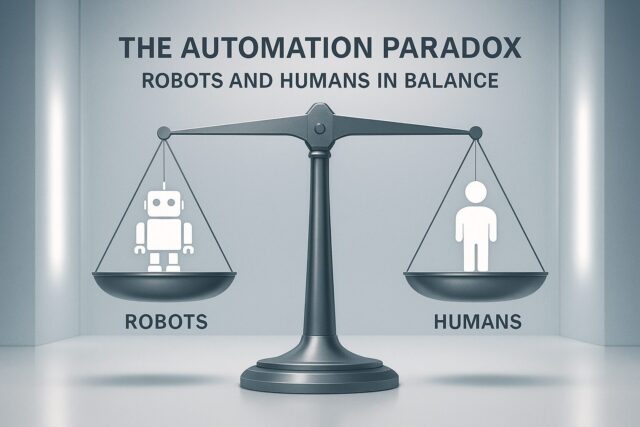
This observation touches on a classic economic tension. Automation tends to increase supply by lowering production costs and raising efficiency. However, when it replaces large numbers of workers, it can also reduce demand—because those workers are also consumers.
Some economists call this the Distributional Challenge: the benefits of productivity gains often flow toward capital owners and highly skilled workers, while displaced employees struggle to find comparable opportunities. If this gap grows too wide, total consumer spending may eventually slow, even as companies produce goods more efficiently than ever.
Automation Beyond the Factory Floor
The conversation has also expanded beyond physical labor.
Earlier waves of automation replaced routine, manual, or hazardous tasks. The current wave, driven by advances in artificial intelligence, is beginning to automate cognitive work — tasks once thought to require human judgment.
AI systems can now analyze legal briefs, generate computer code, assist with financial reviews, and even create marketing content. Analysts often describe this as the next stage of industrial transformation: machines that replace not just muscle, but also reasoning.
According to the World Economic Forum, many of the new jobs created by this transition will demand advanced degrees—an estimated 77% at the master’s level or higher. This could create a skills gap, making it difficult for displaced workers in logistics, administration, or customer service to move into emerging roles that require technical expertise.
Balancing Progress and Participation
Few dispute the value of automation for safety, quality, and global competitiveness.
However, the economic questions it raises—around income distribution, workforce transition, and long-term demand—remain complex and unresolved.
Observers from both industry and academia have suggested that sustained growth will depend not only on technological innovation but also on finding ways to keep people meaningfully engaged in the economy. That might include new models for training, education, or profit-sharing to ensure that productivity gains translate into broader participation.
As automation continues to evolve, one question remains central:
Can an economy remain healthy if efficiency grows faster than opportunity?
Source: For a deeper dive into the automation figures and long-term projections, see the original WION report on YouTube: https://www.youtube.com/watch?v=6SsGtCWHpz8
About the Author

Sami Joueidi holds a Master’s degree in Electrical Engineering and brings over 15 years of experience leading AI-driven transformations across startups and enterprises. A seasoned technology leader, Sami has led customer adoption programs, cross-functional engineering teams, and go-to-market strategies that deliver real business impact.
He’s passionate about turning complex ideas into practical solutions, and about helping teams bridge the gap between innovation and execution. Whether architecting scalable systems or demystifying AI concepts, Sami brings a blend of strategic thinking and hands-on problem-solving to every challenge.
© Sami Joueidi and www.cafesami.com, 2025.
Feel free to share excerpts with proper credit and a link back to the original post.