I still remember the feeling. Back in college, my classmate and I had this grand idea: build a machine vision system that could scan thousands of wooden dowels on a production line and instantly spot defects.
It was a beautiful vision, but it ran straight into the limits of early 2000s tech. Our idea was sound, but the hardware wasn’t. The cameras lacked the resolution, the computers choked on the data, and trying to handle a high-volume factory floor was a non-starter. Machine vision was still in its rigid, rule-based infancy. We shelved the dowel project, but that curiosity—that drive to make machines see—never left me.
My career took me deep into high-speed industrial controls—sorting packages, managing warehouse automation, and moving millions of products across conveyor belts. As an electrical engineer specializing in image and signal processing, I was always the one tasked with finding ways to integrate cameras. I pushed hardware to its absolute limit, always knowing there had to be a smarter, more adaptive way to handle the variability of the real world.
Now, decades later, that smarter way has arrived.
The Problem with the Old Way
What exactly is machine vision? Simply put, it’s the use of cameras and software to perform automated visual checks in industrial environments.
For years, these systems were built on rule-based algorithms. If a part’s shadow was wider than $X$, or if the pixel count in a specific area was $Y$, the part was rejected. This was fast and reliable, but only for tasks that were perfectly consistent and predictable.
The moment the lighting changed, the packaging shifted, or the material subtly varied, the system broke. Engineers had to spend countless hours manually tuning rigid if-then logic—it was a battle of complexity versus reality.
The Paradigm Shift: Adaptive Intelligence
The combination of AI (specifically deep learning) and affordable, powerful GPUs has completely obliterated those old limitations. What once required massive, expensive processing centers can now be done at the edge, in real-time, and with incredible flexibility.
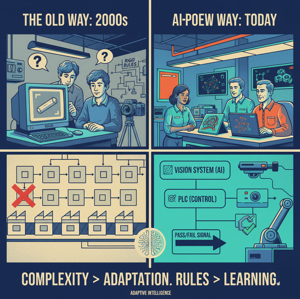
Instead of writing rules for every possible defect, the new systems simply learn. You feed the AI a large dataset of labeled images (both good and bad parts), and it teaches itself to spot subtle anomalies, adapt to noise, and classify complex parts that would make a traditional system seize up.
This is why AI-based vision is a game-changer:
- It handles unpredictable variations in parts and environments naturally.
- It significantly reduces false positives (over-detection), which saves money.
- It requires far less manual tuning and calibration.
- It actually improves its accuracy over time as it processes more data.
Hybrid Systems: Where AI Meets the PLC
So, does AI replace the rock-solid reliability of the traditional rule-based system? Absolutely not. It complements it.
The smartest modern factories are running hybrid systems:
- AI for Anomaly Detection: The AI performs the primary, subtle screening, flagging parts that look unusual or potentially defective—tasks too complex for simple rules.
- Rule-Based Logic for Control: Once the AI makes its decision, the deterministic reliability of the existing PLC (Programmable Logic Controller) takes over.
This integration is key. The vision system (often running on an Industrial PC or IPC) simply sends a Pass/Fail result back to the PLC. The PLC then uses that deterministic output to control the actuators—kicking the bad part off the line or stamping the package.
This layered approach dramatically increases throughput, cuts down on human labor, and creates a quality assurance system that is both incredibly precise and highly resilient.
Final Thoughts: Get Your Hands Dirty
In a world facing labor shortages and ever-increasing quality demands, AI-powered machine vision is no longer a luxury—it’s a necessity. It’s the way we bridge the gap between deterministic automation and adaptive intelligence.
For engineers working in manufacturing, automation, or robotics, learning how to configure and deploy these systems is quickly becoming a critical skill set. The days of fighting with rigid algorithms are over. The future is about teaching machines to see like a human, but with superhuman speed.
Are you already seeing AI-powered vision systems integrated into the PLCs and control strategies at your facility?
About the Author

Sami Joueidi holds a Master’s degree in Electrical Engineering and brings over 15 years of experience leading AI-driven transformations across startups and enterprises. A seasoned technology leader, Sami has led customer adoption programs, cross-functional engineering teams, and go-to-market strategies that deliver real business impact.
He’s passionate about turning complex ideas into practical solutions, and about helping teams bridge the gap between innovation and execution. Whether architecting scalable systems or demystifying AI concepts, Sami brings a blend of strategic thinking and hands-on problem-solving to every challenge.
© Sami Joueidi and www.cafesami.com, 2025.
Feel free to share excerpts with proper credit and a link back to the original post.