When I graduated from engineering school and started my first job, I had something I didn’t particularly like: debt.
I had a student loan, a car loan, and three credit cards. None of my credit card balances were particularly large, and I wasn’t a big spender. But I was making three minimum payments every month, and I had no real understanding of what those payments actually meant.
That, in hindsight, was the problem.
The Gap in Education
We spend years in high school and engineering school learning mathematics, equations, percentages, and how to analyze complex systems.
I knew the mathematics.
What I had never done was connect that mathematics to my own financial life.
I never stopped to think about what a 22% interest rate meant when applied to my credit card balance. I didn’t connect the concept of compounding interest to the balance I was carrying, or really think about what making only the minimum payment meant over time.
The math was familiar.
The application wasn’t.
And that points to an interesting gap in education: we spend years learning how to use mathematics to solve engineering problems, but we don’t always learn how those same concepts show up in our everyday decisions.
My father had given me one simple lesson growing up: don’t owe anyone any money.
That lesson stayed with me. But knowing that I didn’t want debt and understanding how to get out of it were two completely different things.
The Work Ethic and the Routine
While in engineering school, I worked three jobs:
-
Taught French and math part-time at a high school
-
Worked as a computer consultant in the university labs
-
Worked as an electrician at the university during the summers
The schedule worked well. The jobs paid reasonably well without consuming all my time, allowing me to take a full course load, study, and enjoy college.
I had my routine.
I worked. I studied. I went out and had fun with friends. I paid my bills.
Every month, I made my car payment and the minimum payments on my three credit cards.
Everything seemed fine.
Until one day, I went to the bank to make my car payment.
The Conversation in the Bank
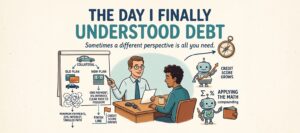
Sometimes a different perspective is all you need. Understanding the math is only half the battle; knowing how to apply it to your life is what leads to freedom.
Back then, there were no online or automatic payments. You mailed a check or walked into the branch.
I went in to make my usual payment and ended up talking with a loan officer I had never met before.
He looked at my finances and started asking questions. He noticed I was making minimum payments on three credit cards with high interest rates.
Then he explained something that was completely new to me.
If I continued making only the minimum payments, I could be making those payments for a very long time.
I was paying, but I wasn’t really moving toward the finish line.
He suggested a different approach.
My car was already close to being paid off. He suggested using it as collateral for a new loan, paying off all three credit cards, and moving that debt to a much lower interest rate.
If I remember correctly, the credit cards were around 22% and the new loan was around 6%.
The plan was simple:
-
Pay off the three credit cards.
-
Pay off the remaining balance on my car loan.
-
Combine what I had been paying toward the car and credit cards into one monthly payment.
-
Continue making roughly the same total monthly payment until the new loan was paid off.
-
If I stayed with the plan, I could eliminate the new loan in about six months.
He also explained something else I knew very little about at the time: my credit score.
He explained why having good credit mattered and how paying off the loan as planned could help establish a stronger credit history. He told me that I should start seeing an impact in about six months.
I asked him to take care of everything right there.
The bank already had the title to my car, and he had access to my account, so we handled the transactions while I was in his office.
The credit cards were paid off.
The car loan was paid off.
And I walked out of the bank with one loan and a clear plan to eliminate it.
A Change in Perspective
The whole meeting took a couple of hours.
When I walked out, I felt relieved.
Not because I had avoided paying what I owed, but because I had finally understood what I was dealing with and had a plan to get out of it.
That conversation changed the way I looked at money.
I knew I still had a student loan waiting for me. My first payment wasn’t due until six months after graduation.
Instead of waiting for that first bill to arrive, I opened a separate account and started putting money aside.
I kept saving.
By the time the student loan payment came due, I had already been preparing for it for a long time.
That was another important realization for me: when you know something is coming, you can prepare for it instead of simply reacting when it arrives.
Years later, I would have another financial “aha” moment when a good friend picked up Personal Finance for Dummies at Borders after one of our Saturday morning workout routines.
That book opened another door for me.
I ended up giving copies to several friends because I wanted them to have the same opportunity to learn the basics of personal finance in a simple, accessible way.
Later still, another good friend introduced me to Rich Dad Poor Dad, which opened an entirely different chapter in how I thought about money, including the distinction people often make between “good debt” and “bad debt.”
Those are stories for another post.
The Real Lesson
Looking back, the most important financial lesson I learned started with a conversation I wasn’t even looking for.
I went to the bank to make a car payment.
I walked out seeing debt differently.
I learned that knowing the mathematics isn’t the same as knowing how to apply it.
Making payments isn’t the same as understanding debt.
And having a plan, and the discipline to follow it, matters.
But perhaps the biggest lesson was something even simpler.
Sometimes we don’t need someone to teach us something completely new.
Sometimes we just need someone to help us see what we already know in a different context.
I knew mathematics.
I just hadn’t connected it to my own life.
And you never know who you’re going to meet, or what one conversation might change for you.

Sami Joueidi holds a Master’s degree in Electrical Engineering and brings over 15 years of experience leading AI-driven transformations across startups and enterprises. A seasoned technology leader, Sami has led customer adoption programs, cross-functional engineering teams, and go-to-market strategies that deliver real business impact.
He’s passionate about turning complex ideas into practical solutions, and about helping teams bridge the gap between innovation and execution. Whether architecting scalable systems or demystifying AI concepts, Sami brings a blend of strategic thinking and hands-on problem-solving to every challenge. © Sami Joueidi and www.cafesami.com, 2025. Feel free to share excerpts with proper credit and a link back to the original post.