
When I was in college, I bought textbooks.
That probably sounds like an unremarkable statement.
It wasn’t.
I studied engineering, and some of those books cost $60, $80, sometimes even $100. At the time, I remember thinking that was a lot of money for a book.
But I owned the book.
I could underline something. I could put a tiny mark next to a formula. I could circle a sentence that I knew would matter later.
And I did.
Sometimes, during an exam, I could almost visualize the page where I had seen a particular formula. I might not remember the page number, but I remembered where on the page it was. I could see the book in my mind.
That may sound strange, but there was something about physically interacting with the material that created a memory beyond the words themselves.
And the book didn’t disappear when the semester ended.
I had choices.
I could keep it.
I could put it on a shelf and use it as a reference years later.
Or I could sell it to another student.
A $60 textbook might become a $40 used textbook. I lost some money, of course, but I had essentially rented it on my own terms.
That felt like a pretty good deal.
Then my son went to college
Years later, my son started college, and I discovered that textbooks had changed.
He wasn’t necessarily buying them.
He was subscribing to them.
The first time I heard that, I thought there had to be some misunderstanding.
But no.
In some cases, a digital textbook can cost well over $100 for a semester.
You pay for access.
You use it for the course.
The semester ends.
And the access ends.
You don’t have a book to put on a shelf.
You can’t sell it to another student.
You can’t pull it off the shelf five years later when you suddenly need to remember something.
And here’s where it became particularly interesting to me.
Suppose the course continues into the next semester and the professor uses the same textbook, but the class now covers the next section of it.
You might have to subscribe again.
You aren’t buying the knowledge.
You are renting permission to access it.
That distinction bothered me.
Not because I believe authors, publishers, or educators shouldn’t be compensated. Quite the opposite.
There is enormous intellectual capital behind a good textbook. Someone spent years learning, researching, writing, editing, illustrating, and organizing that knowledge.
That deserves compensation.
But I started wondering:
At what point does compensation for intellectual property become a permanent toll for accessing knowledge?
The subscription model was supposed to make things easier
I have spent much of my career around software, including selling software in the enterprise world.
I understand why the subscription model was attractive.
Instead of asking a customer to purchase a huge number of licenses upfront, you could spread the cost over time.
You could scale up when you needed more users and scale down when you needed fewer.
The vendor could provide continuous updates and support.
The customer didn’t have to make a massive capital investment.
On paper, it made tremendous sense.
And sometimes it still does.
But somewhere along the way, “pay as you go” became “pay forever.”
And those are not the same thing.
Take Microsoft Office
I have a Microsoft 365 subscription.
If I stop renewing it, Microsoft doesn’t take my Word documents and Excel spreadsheets away from me.
At least there is some sanity left in the world.
I can still access my existing documents, but the desktop applications move into a reduced-functionality/read-only state until I renew.
And I understand why Microsoft does it.
They built the software. They maintain it. They provide updates, security patches, cloud services, collaboration features, and support.
They deserve to make money.
But there is something psychologically different about paying for a product once and paying indefinitely for permission to continue using it.
Imagine buying a refrigerator and being told that after three years you could still open the refrigerator and look at your food, but you would have to subscribe again to use the cooling function.
We would probably laugh at that.
Yet in software, we have gradually accepted variations of the same idea.
The cloud has another version of the same trap
Then there is cloud storage.
The cloud was revolutionary.
Instead of buying servers, hard drives, backup systems, networking equipment, cooling, power, and data-center space, companies could simply store their data with a cloud provider.
It was convenient.
It was scalable.
It was accessible.
And initially, the pricing looked incredibly attractive.
Put your data in the cloud.
Pay only for what you use.
What could go wrong?
Years later, some organizations discovered the answer.
Getting the data out.
This is where I think the subscription and cloud models share something important.
The easiest part is getting in.
The difficult part can be leaving.
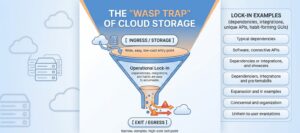
I think of it as a wasp trap.
A wasp trap has a large opening. The wasp can enter easily because the path is designed to be attractive and convenient.
But once inside, finding the way back out is another matter.
The cloud can sometimes feel the same way.
Moving terabytes or petabytes of data into a cloud provider can be relatively inexpensive compared with the cost of operating your own infrastructure.
But once your organization has accumulated years of data, applications, integrations, security configurations, and operational processes around that provider, moving somewhere else can become extraordinarily expensive and complicated.
And now you aren’t just paying for storage.
You’re paying for the cost of leaving.
That’s a very different economic relationship.
The real product may not be the service
This is where I think the subscription model deserves more scrutiny.
The initial sale is often about convenience:
Don’t buy it. Subscribe.
You don’t need to own the infrastructure.
You don’t need to maintain it.
You don’t need to manage upgrades.
You don’t need to make a large upfront investment.
And all of those arguments can be completely legitimate.
But the longer you stay, the economics can change.
The vendor gains recurring revenue.
The customer gains convenience.
But the customer may also accumulate dependency.
And dependency has economic value.
Once your documents, data, workflows, integrations, and habits are deeply embedded in a platform, switching isn’t simply a matter of choosing a different product.
There is a cost to leaving.
That cost can become the most powerful retention mechanism of all.
We have seen this movie before
I remember another example from years ago.
When traffic cameras first started being discussed, I remember hearing explanations about how they would be used to monitor traffic flow, understand congestion, and improve transportation.
The idea sounded reasonable.
Who could argue with better information about traffic?
But eventually, cameras were also being used for things like red-light enforcement and speed enforcement.
The technology didn’t necessarily change.
The use of the technology expanded.
And that is another lesson I have learned:
The original promise of a technology isn’t always the final business model.
A system can begin with one purpose and gradually evolve into something much broader.
The same thing can happen with subscriptions.
The original argument may be:
Lower upfront cost.
Then:
Continuous updates.
Then:
Better service.
Then:
Cloud integration.
Then:
Premium features.
Then:
Higher prices.
And eventually, you realize that the thing you once thought you purchased has become something you can only use as long as you continue paying.
I’m not against subscriptions
That’s important.
Subscriptions can be fantastic.
I don’t want to buy a new server every time software needs an update.
I don’t want to maintain my own data center just to run an application.
I don’t want to purchase a new GPS database every year.
There are products and services where recurring payment makes perfect sense.
The problem isn’t the subscription.
The problem is when we stop asking what happens if we stop subscribing.
What happens to my data?
What happens to my work?
What happens to my ability to export everything?
What happens to my ability to use what I already created?
What does it cost to leave?
And perhaps the most important question:
What exactly do I own?
Maybe that’s the question we should have been asking all along
When I was a student, I bought a textbook for $80.
I thought I was buying an expensive book.
Looking back, I realize I was buying something else.
I was buying access to knowledge with no expiration date.
I could mark it.
I could lend it.
I could sell it.
I could keep it for 20 years.
I could open it again because I had forgotten something.
The physical object represented a small piece of intellectual property that I had legitimately acquired the right to use indefinitely.
Today, we are surrounded by services that offer something different.
Not ownership.
Access.
Access can be cheaper.
Access can be easier.
Access can be more convenient.
But access can also be revoked.
And when enough of our lives, work, knowledge, and data move into systems that operate on perpetual access, we need to be honest about what we are creating.
Because sometimes the cheapest way in is also the most expensive way out.
And perhaps that’s the question I would ask before subscribing to anything:
If I stop paying tomorrow, what do I still have?

Sami Joueidi holds a Master’s degree in Electrical Engineering and brings over 15 years of experience leading AI-driven transformations across startups and enterprises. A seasoned technology leader, Sami has led customer adoption programs, cross-functional engineering teams, and go-to-market strategies that deliver real business impact.
He’s passionate about turning complex ideas into practical solutions, and about helping teams bridge the gap between innovation and execution. Whether architecting scalable systems or demystifying AI concepts, Sami brings a blend of strategic thinking and hands-on problem-solving to every challenge. © Sami Joueidi and www.cafesami.com, 2025. Feel free to share excerpts with proper credit and a link back to the original post.