
In healthcare, technology decisions aren’t just technical — they are strategic. Every integration, deployment, and platform design choice impacts patient outcomes, regulatory compliance, and the company’s ability to innovate.
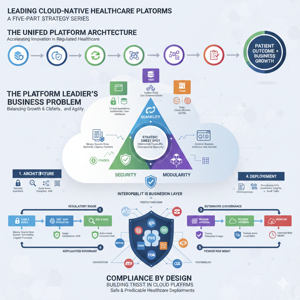
Strategic framework for leading cloud-native healthcare platforms, integrating business goals, technical design, and regulatory compliance.
This five-part series explores the real-world challenges of building and leading a cloud-native platform that supports SaaS, PaaS, and DaaS delivery models in regulated healthcare environments. Written from the perspective of a Senior Manager / Director of Platform Engineering, the series blends 60% business and leadership insight with 40% technical depth, showing how platform leaders turn complexity into strategic advantage.
Post 1: Designing Cloud-Native Platforms for Regulated Healthcare
Key Focus: Introducing the concept of treating a platform as a product, balancing business and technical priorities.
Intro Hook: “Building a platform in healthcare is never just about code. It’s about accelerating clinical outcomes while mitigating risk.”
- SaaS, PaaS, DaaS as strategic levers, not just deployment models
- Platform decisions framed as business outcomes: reducing time-to-market, enabling clinical insights
- Golden Paths and Infrastructure-as-Policy: how technical design supports regulatory and operational goals
- Cross-functional collaboration as a critical success factor
Leadership Takeaway: Executives care less about frameworks, more about how the platform accelerates business and patient impact.
Post 2: Balancing Scalability, Security, and Modularity in Healthcare Platforms
Key Focus: How to architect a platform that grows safely and sustainably.
Intro Hook: “Scalability without governance is chaos. Security without scale is bottleneck. Modularity without vision is fragmentation.”
- Using cell-based architecture and microservices to isolate and scale workflows
- Embedding security and compliance checks into modular components
- Decision-making as risk mitigation: how technical choices impact cost, regulatory posture, and operational resilience
- Real-life examples of balancing growth and operational maturity
Leadership Takeaway: The right architectural choices aren’t just technical — they enable the business to scale safely.
Post 3: Interoperability Is a Business Problem: Integrating Lab Systems with Clinical Systems at Scale
Key Focus: Framing interoperability as a strategic, business-critical capability.
Intro Hook: “Standards like FHIR, HL7, and DICOM exist, but true interoperability is a design problem — and a leadership conversation.”
- Standards don’t remove variability; they expose it
- Building interoperability layers that insulate the core platform from messy external systems
- Asynchronous data flows as a risk mitigation strategy
- Data ownership, auditability, and accountability baked into platform design
Leadership Takeaway: Interoperability isn’t a technical footnote; it’s a strategic lever to accelerate outcomes while minimizing risk.
Post 4: Deployments and Change Management in Regulated Environments
Key Focus: Executing platform changes safely, predictably, and at scale.
Intro Hook: “In healthcare, deployments are business decisions. Every release impacts patients, partners, and compliance.”
- Continuous compliance transforms audits from stress points into non-events
- Golden Paths enable safe, automated deployments while maintaining regulatory rigor
- Canary releases, feature flags, and observability dashboards as trust-building tools
- Change management as a business strategy, not just a process
Leadership Takeaway: Deployments and change management are where technical excellence meets business risk management.
Post 5: Compliance by Design: Building Trust in a Cloud-Native Healthcare Platform
Key Focus: Ensuring the platform meets HIPAA, CLIA, IVDR, FDA, and other regulations by design.
Intro Hook: “Can we trust this platform to be compliant — all the time, not just on audit day?”
- Framing compliance as a business conversation first, technical second
- Embedding regulatory guardrails into platform architecture: encryption, IAM, auditability
- Continuous compliance: real-time enforcement of policies and automated reporting
- Cloud-native architecture as a tool to turn compliance from overhead into a strategic advantage
Leadership Takeaway: Compliance is not a constraint — it’s a strategic enabler for innovation, growth, and trust.
Series Closing Note
Building cloud-native platforms in regulated healthcare requires a rare mix of technical depth and business acumen. Across these five posts, the goal has been to show how platform leaders:
- Treat the platform as a strategic product
- Balance scalability, security, and modularity with business risk
- Integrate complex lab and clinical systems while insulating the core
- Deploy and change safely in regulated environments
- Embed compliance into the architecture to enable trust and innovation
For executives, engineers, and platform leaders alike, the lesson is clear: technical decisions are business decisions, and regulatory guardrails are growth enablers when applied thoughtfully.

Sami Joueidi holds a Master’s degree in Electrical Engineering and brings over 15 years of experience leading AI-driven transformations across startups and enterprises. A seasoned technology leader, Sami has led customer adoption programs, cross-functional engineering teams, and go-to-market strategies that deliver real business impact.
He’s passionate about turning complex ideas into practical solutions, and about helping teams bridge the gap between innovation and execution. Whether architecting scalable systems or demystifying AI concepts, Sami brings a blend of strategic thinking and hands-on problem-solving to every challenge.
© Sami Joueidi and www.cafesami.com, 2025.
Feel free to share excerpts with proper credit and a link back to the original post.