If there’s one topic that consistently brings both excitement and anxiety into leadership discussions, it’s interoperability.
On paper, integrating lab systems with clinical systems sounds straightforward. We have standards — HL7, FHIR, DICOM. We have APIs. We have cloud platforms built for scale.
In reality, this is where platform decisions are stress-tested.
Where the Conversation Usually Starts
The question I hear most often from leadership is:
“Why does integrating lab and clinical systems take so long?”
It’s a fair question. After all, the business case is clear:
- Faster data exchange improves clinical decision-making
- Better integration reduces manual workflows in labs
- More connected systems unlock downstream analytics and insights
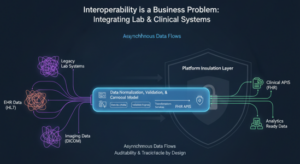
The Interoperability Bridge—using a dedicated insulation layer to transform external data variability into predictable, platform-ready insights.
But the complexity doesn’t come from the idea of integration. It comes from the variability — and that variability has real business consequences.
Standards Don’t Eliminate Variability — They Expose It
One of the most important conversations I have with executives is resetting expectations around standards.
FHIR, HL7, and DICOM are essential — but they are not magic.
In practice:
- Different labs implement standards differently
- Legacy systems interpret fields inconsistently
- Data quality varies based on workflow, not schema
From a platform perspective, assuming “standards-compliant” equals “plug-and-play” is one of the fastest ways to introduce operational risk.
That’s why interoperability needs to be treated as a first-class platform capability, not a one-off integration effort.
The Platform’s Role: Insulating the Core
When discussing integration strategy with leadership, I often use this framing:
Our core platform should never have to care how messy the outside world is.
This leads to a clear architectural principle:
- Insulate the core platform from external variability
Technically, this means:
- Dedicated interoperability layers
- Canonical data models
- Asynchronous data flows that absorb inconsistencies without blocking core workflows
From a business perspective, it means:
- Faster onboarding of labs and partners
- Fewer production incidents caused by edge cases
- Predictable behavior even when upstream systems change
This insulation is what allows the platform to scale without rewriting the same logic over and over again.
Why Asynchronous Matters More Than It Sounds
One of the most impactful — and often underestimated — decisions is moving away from tightly coupled, synchronous integrations.
In regulated environments, synchronous integrations create fragile dependencies:
- One system slows down, everything backs up
- Errors become harder to isolate
- Recovery paths become manual and risky
By embracing asynchronous patterns:
- The platform can buffer, validate, and audit data flows
- Failures are isolated instead of cascading
- Compliance requirements are easier to enforce consistently
This isn’t just a technical preference — it’s a risk mitigation strategy that leadership immediately understands once framed that way.
Data Ownership, Trust, and Accountability
Another leadership-level concern that surfaces quickly is data ownership:
- Who owns the data at each stage?
- Who is accountable if something is delayed or incorrect?
- How do we prove what happened during an audit?
This is where platform design directly supports regulatory confidence.
Clear boundaries around:
- Data ingress
- Transformation
- Storage
- Access
allow us to provide auditability and traceability by design, not as an afterthought.
Executives care about this because it directly impacts:
- Regulatory exposure
- Partner trust
- Brand reputation
Interoperability as an Enabler, Not a Bottleneck
When interoperability is treated as a side project, it becomes a bottleneck. When it’s designed as a platform capability, it becomes an enabler.
The shift I aim for in leadership discussions is this:
- From “Why is this so hard?”
- To “How do we make this repeatable and safe?”
Once that shift happens, investments in interoperability stop feeling like overhead and start feeling like strategic leverage.
Closing Thought
Integrating lab systems with clinical systems isn’t just about moving data — it’s about preserving trust while accelerating outcomes.
The platforms that succeed at scale are the ones that:
- Expect variability
- Design for it explicitly
- And shield the business from its impact
In the next post, I’ll talk about how these integration-heavy platforms are deployed and evolved safely — deployments and change management in regulated environments, where the cost of getting it wrong is far higher than a failed release.

Sami Joueidi holds a Master’s degree in Electrical Engineering and brings over 15 years of experience leading AI-driven transformations across startups and enterprises. A seasoned technology leader, Sami has led customer adoption programs, cross-functional engineering teams, and go-to-market strategies that deliver real business impact.
He’s passionate about turning complex ideas into practical solutions, and about helping teams bridge the gap between innovation and execution. Whether architecting scalable systems or demystifying AI concepts, Sami brings a blend of strategic thinking and hands-on problem-solving to every challenge. © Sami Joueidi and www.cafesami.com, 2025. Feel free to share excerpts with proper credit and a link back to the original post.