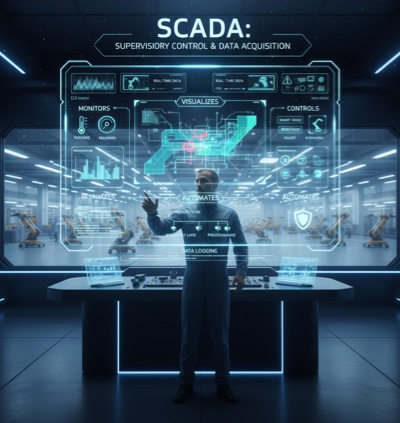
The insights and practical guidance in this article are inspired by Alana, a seasoned control systems engineer and educator. Her in-depth explanations of industrial communication protocols—Modbus, DNP3, and IEC 60870—help make complex topics approachable for engineers at every level. Through her technical walkthroughs, she brings clarity to foundational SCADA concepts that often confuse even experienced professionals.
Explore more of her work on YouTube.
In modern control systems, communication protocols are the backbone of SCADA (Supervisory Control and Data Acquisition) environments. These protocols define how field devices and control systems exchange data, monitor operations, and respond to events. Choosing the right protocol directly impacts interoperability, scalability, security, and long-term maintainability.
Why Open Protocols Matter
Open protocols like Modbus, DNP3, and IEC 60870-5-104 are critical for building robust and future-ready automation systems because they:
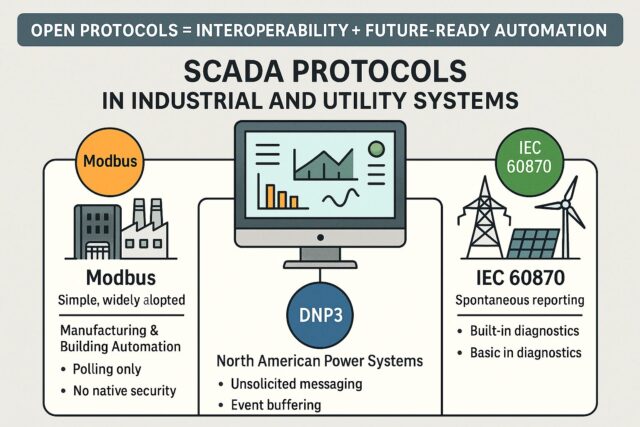
- Enable vendor-neutral integration across devices and platforms
- Avoid licensing fees and proprietary lock-in
- Support community-driven development and better troubleshooting
- Facilitate future-proofing for cloud, edge computing, and AI integration
Protocol Comparison: Modbus vs. DNP3 vs. IEC 60870-5-104
| Feature | Modbus | DNP3 | IEC 60870-5-104 |
|---|---|---|---|
| Origin | 1979, Modicon (now Schneider) | 1990s, utility-focused | European standard |
| Architecture | Master-slave | Master-outstation | Client-server |
| Communication | Polling only | Polling + unsolicited | Polling + spontaneous |
| Transport | Serial (RTU/ASCII), Ethernet | Serial, Ethernet | TCP/IP |
| Security | None (native) | Optional secure authentication | Basic security features |
| Time Sync | None | Built-in, high precision | Built-in |
| Event Buffering | No | Yes | Yes |
| Data Types | Simple (registers, coils) | Rich (analog, digital, counters) | Rich, flexible addressing |
| Industry Focus | Industrial automation | North American power systems | European/international power systems |
When to Use Each Protocol
Modbus
Industry Focus: Manufacturing, process control, building automation
Use Cases:
- Modbus RTU (RS485): Temperature sensors, flow meters, field instruments
- Modbus TCP (Ethernet): PLCs, HMIs, SCADA across plant networks
Why It Works:
- Simple and widely adopted
- No licensing required
- Ideal for small to medium systems with polling-only communication
DNP3
Industry Focus: North American electric utilities (transmission & distribution)
Use Cases:
- Substation automation
- Event logging and fault detection
- Water treatment and distribution systems
Key Advantages:
- Supports unsolicited messaging for immediate alerts
- Time synchronization built-in
- Event buffering during comms outages
- Efficient multi-type data handling
IEC 60870-5-104
Industry Focus: European power systems, international utilities, renewable energy (wind/solar)
Use Cases:
- Grid and substation monitoring
- Renewable integration (wind, solar farms)
- Cross-border utility coordination
Why It Stands Out:
- Spontaneous event reporting
- Information object addressing (flexible, albeit complex)
- Built-in diagnostics and test tools
- Strong adoption in European and global utility sectors
DNP3 vs. IEC 60870-5-104: Key Differences
| Aspect | DNP3 | IEC 60870-5-104 |
|---|---|---|
| Addressing | Point-based (simple, direct) | Information object-based (flexible, complex) |
| Regional Focus | North America | Europe, growing globally |
| Maintenance Features | Basic | Built-in diagnostics for safe testing |
Final Guidance
- Use Modbus for its simplicity and universal compatibility in industrial and building automation.
- Use DNP3 for utility systems that require robust event handling, unsolicited messaging, and precise time synchronization—especially in North America.
- Use IEC 60870-5-104 for international utility applications, renewable energy integration, and projects involving European standards or OEMs.
Why It All Matters
Understanding the “why” behind these protocols—not just their technical specs—helps engineers and integrators:
- Build resilient, scalable, and secure control systems
- Troubleshoot more effectively in the field
- Choose the right tool for each job based on system requirements and industry standards
Ready to future-proof your SCADA architecture?
Whether you’re monitoring substations, integrating solar farms, or just getting started with PLCs, knowing how and when to use these open protocols will set you (and your system) up for long-term success.
About the Author

Sami Joueidi holds a Master’s degree in Electrical Engineering and brings over 15 years of experience leading AI-driven transformations across startups and enterprises. A seasoned technology leader, Sami has led customer adoption programs, cross-functional engineering teams, and go-to-market strategies that deliver real business impact.
He’s passionate about turning complex ideas into practical solutions, and about helping teams bridge the gap between innovation and execution. Whether architecting scalable systems or demystifying AI concepts, Sami brings a blend of strategic thinking and hands-on problem-solving to every challenge.
© Sami Joueidi and www.cafesami.com, 2025.
Feel free to share excerpts with proper credit and a link back to the original post.