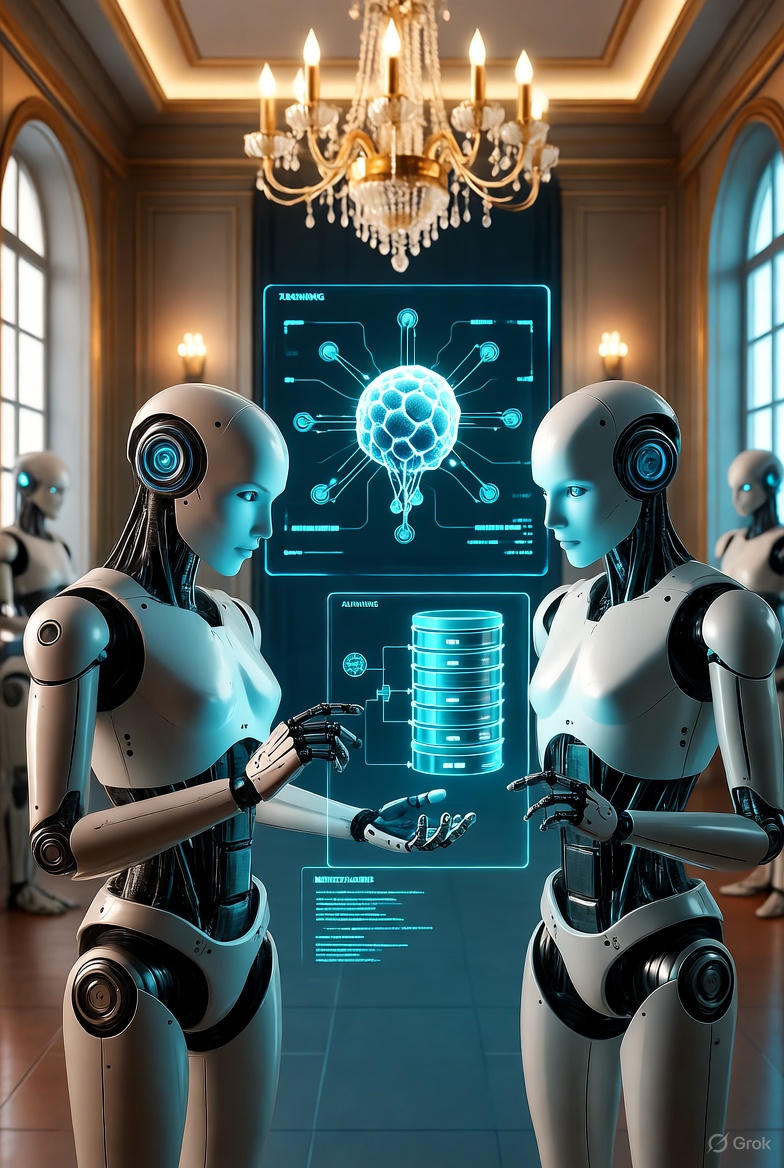
As an electrical engineer, my earliest and deepest professional passion was always control systems. Years ago, before my current role in Data and AI at IBM, I spent my days designing and implementing a full warehouse control system for a manufacturing company. My job was to engineer the entire operational brain to sort and divert boxes for shipment, relying on a complex mix of PLCs, sensors, motors, and supervisory servers.
The greatest frustration was the rigidity of the logic. I had to anticipate every single possible scenario, creating brittle code and forcing me to rely on a ‘catch-all’ manual sorting chute and emergency shutdowns. That experience, though rewarding, left me with a fundamental question about scalability and intelligence.
Now, my professional role doesn’t directly touch control systems, but that old curiosity never died. It led me to spend my evenings and weekends researching and prototyping an answer: What does it look like to infuse AI into industrial control systems—without replacing what already works? I’m currently building this design at home using a PLC and an AI microcontroller I purchased just for this project.
This post is a reflection on that personal research journey—a quest to see how modern AI techniques, especially agent-based systems and large language models (LLMs), can augment the traditional systems I used to build.
Overview: Why AI + PLCs
PLCs are the undisputed backbone of industrial automation, responsible for real-time I/O, safety interlocks, and deterministic control. Crucially, they don’t “think” beyond their predefined logic. AI, on the other hand, excels at pattern recognition, adaptive behavior, and high-level reasoning.
Bridging these two worlds—connecting the deterministic precision of the PLC with the adaptive intelligence of an AI agent—opens the door to powerful capabilities:
- Predictive maintenance based on subtle sensor anomalies.
- Intelligent routing and logistics that adapt to real-time inventory.
- Adaptive safety logic that learns from near-miss events.
- Optimization based on historical patterns far too complex for ladder logic.
What Is PLC Integration?
At its core, a PLC is an industrial-grade controller that interfaces with sensors and actuators. Any AI system that wishes to integrate into this ecosystem must “speak the language” of the PLC’s industrial protocols, which typically include:
- Modbus (TCP/RTU)
- OPC UA
- EtherNet/IP
- Profinet
- MQTT (for lightweight IoT messaging)
The Role of AI in Control Systems
The key is parallel operation. Instead of replacing PLCs, AI systems can operate in parallel, acting as a higher-level decision-maker and orchestrator. It manages the complexity that my warehouse control system once struggled with.
- AI as Decision-Maker An LLM or specialized AI model can analyze massive amounts of sensor data, operator inputs, or logs. It can generate high-level commands like “Pause system,” “Alert maintenance,” or “Switch to backup tank,” which are then translated into PLC actions.
- Agentic Orchestration AI agents are designed to: interpret real-world inputs (like barcode scans and weights), decide on control logic dynamically based on inventory levels, and communicate the precise actions to the PLC using industrial protocols.
- AI-Controlled Communication Layer The AI system, often running on an Edge device (my microcontroller), can issue commands directly and reliably using libraries in a language like Python for example: pymodbus (for Modbus), opcua (for OPC UA), or pycomm3 (for EtherNet/IP), allowing the AI to integrate seamlessly.
Abstracted System Components
- Component: Edge AI Device | Role: Runs AI agents and LLMs locally
- Component: AI Framework | Role: Handles orchestration and decisioning
- Component: Industrial Controller | Role: Executes I/O and safety logic
- Component: Sensors/Actuators | Role: Provide real-world input/output
- Component: Protocol Layer | Role: Modbus, OPC UA, or MQTT for messaging
Use Case: Smart Conveyor + Inventory Management
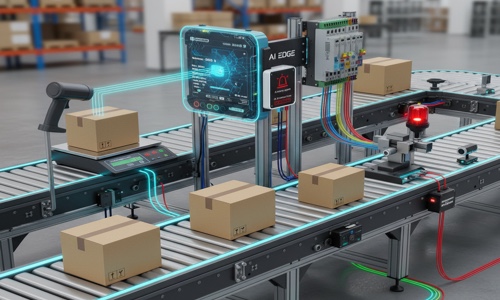
The intelligence I am prototyping at home centers around this concrete application: Automating a warehouse conveyor system based on item type and weight.
- AI Tasks: Interpret barcode data, check inventory levels, decide routing path or manual handling.
- Control Actions: Start/stop conveyors, trigger diverters or alarms.
- Safety Integration: An AI Safety Agent monitors for thresholds (e.g. overheating, blockage) and can issue overrides or emergency stop commands, solving the brittle safety logic of my old system.
Deployment Options: Flexibility at the Edge
You can deploy this architecture with:
- Simulators for both AI agents and PLCs (great for testing)
- Edge devices (any SBC or microcontroller + AI inference)
- Local-only architectures (for security and air-gapped environments)
Safety & Responsibility
A paramount lesson remains: Safety is non-negotiable. While AI can greatly enhance control systems, it should never bypass the critical, deterministic safety controls. Always maintain:
- Hardwired emergency stops
- Redundant control paths
- Operator overrides
AI should augment, not override, your risk mitigation strategies.
Final Thoughts
This is an exciting time to be an engineer, regardless of your current field. Moving beyond the rigid logic I faced in my first job, AI integration allows us to build intelligent, adaptive, and data-driven automation. My weekend project is proving that we now have a toolbox to enhance functionality while preserving the reliability of traditional control systems.
Whether you’re retrofitting legacy equipment or designing the next smart factory, AI is the key to creating automation systems that not only execute but truly learn.
Stay tuned on CafeSami as I continue exploring practical architectures, open-source tools, and implementation guides.
About the Author

Sami Joueidi holds a Master’s degree in Electrical Engineering and brings over 15 years of experience leading AI-driven transformations across startups and enterprises. A seasoned technology leader, Sami has led customer adoption programs, cross-functional engineering teams, and go-to-market strategies that deliver real business impact.
He’s passionate about turning complex ideas into practical solutions, and about helping teams bridge the gap between innovation and execution. Whether architecting scalable systems or demystifying AI concepts, Sami brings a blend of strategic thinking and hands-on problem-solving to every challenge.
© Sami Joueidi and www.cafesami.com, 2025.
Feel free to share excerpts with proper credit and a link back to the original post.